
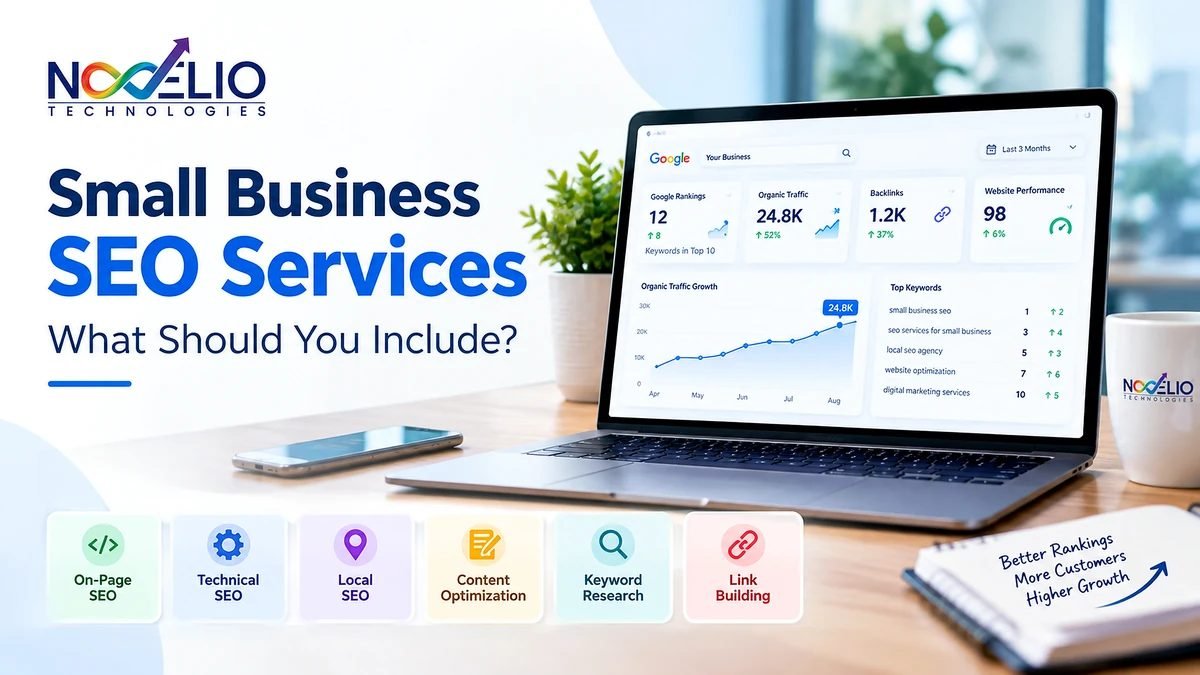
Small Business SEO Services: What to Buy, What to Pay, and How to Choose
Small Business SEO SEO Services Local SEO SEO Strategy Lead Generation
Your website is live. Your services are listed. But the calls and inquiries you expected are not coming in.
Before paying for more blogs or backlinks, ask a more useful question: What is stopping the right customers from finding your business and contacting you?
Small business SEO services should help answer that question, fix the problems that matter, and measure whether your website is creating better business opportunities.
This guide explains what to include in your SEO investment, how to compare quotes, and what to check before choosing a provider.
Already comparing agencies? Explore NovelioTech’s SEO services and request a quote based on your website, location, and business goals.
Table of Contents
- Do You Need Small Business SEO Services?
- What Are Small Business SEO Services?
- What Should Small Business SEO Services Include?
- Which SEO Services Should a Small Business Prioritize?
- How to Compare SEO Providers Before Signing
- How Do You Know If Your SEO Investment Is Working?
- What Should the First 90 Days Look Like?
- Choose SEO Around Your Business Goal
- FAQs
Do You Need Small Business SEO Services?
SEO is worth evaluating when people search for what you sell and your business is missing from those searches. You may need professional help if:
- Competitors appear for your main services while your website is hard to find.
- Most of your search traffic comes from people who already know your business name.
- Your website gets visits but few relevant calls or inquiries.
- Important service pages are missing, unclear, or difficult to use on mobile.
- You have paid for SEO before but cannot see what changed or what it achieved.
However, SEO takes ongoing work. If you need sales immediately, discuss how it will fit alongside faster acquisition channels. If few customers search for your offer, first check whether search is the right place to invest.
What Are Small Business SEO Services?
Small business SEO services are the strategy and ongoing optimization used to improve organic search visibility and attract relevant prospects. The work can include technical SEO, keyword targeting, service-page optimization, content, local SEO, internal linking, authority building, and conversion optimization.
The right mix depends on the business. A local service company may need strong local SEO and location-focused pages, while a company serving customers across the country may need a broader national strategy. The objective is not to buy every SEO service available, but to invest in the areas most likely to improve business results.
What Should Small Business SEO Services Include?
A good SEO service should be based on the website’s current condition, target customers, competition, and business goals rather than a fixed checklist.
1. A Website Audit With Clear Priorities
An audit should explain which problems need attention first and who will fix them.
For example, a broken inquiry form needs immediate attention. A missing page for a profitable service may deserve more attention than another general blog. A technical error affecting an important page may matter more than dozens of minor tool warnings.
Ask for a list of priority pages, recommended changes, responsibilities, and the baseline used to measure progress. Confirm whether the fee includes implementation or only advice.
2. Keyword Research Connected to Buying Decisions
Keyword research should consider search intent, not just search volume. Someone searching for “SEO” has broad intent, while someone searching for “SEO services for small business” is closer to evaluating a provider.
A useful keyword strategy connects valuable searches to specific services and the pages best suited to answer them. Depending on the query, this could be a service page, location page, product page, or educational article.
For example, someone searching for “how to clean a sofa” may want instructions. Someone searching for “professional upholstery cleaning in Tampa” may be comparing providers. Both searches can support a content plan, but with a limited budget, service and location searches deserve priority because they connect more directly to the offer.
The goal is a keyword-to-page strategy that brings relevant visitors to pages that help them take the next step.
3. On-Page and Technical SEO
On-page SEO improves titles, headings, content structure, metadata, internal links, and overall alignment with search intent. A strong page should clearly answer the searcher’s question while explaining the product, service, or solution and providing an appropriate next step.
Technical SEO addresses problems that can affect crawling, indexing, performance, or usability. Depending on the site, this can include redirects, canonicalization, XML sitemaps, duplicate URLs, structured data, mobile usability, and other technical issues.
Not every business needs the same technical work every month. The priority should be problems that can genuinely limit visibility, usability, or conversions.
4. Local SEO Where Your Business Is Eligible
Local SEO services for small business help businesses reach customers searching for providers in specific cities, counties, regions, or service areas. The scope may include Google Business Profile optimization for eligible businesses, website improvements, accurate and consistent business information, genuine customer reviews, and useful location pages.
Adding a city name to a page is not enough. Your website should clearly explain what you offer, where you operate, and why customers in that area should choose you. Each location page should describe the services available there and provide useful local details. Repeating the same copy with a different city name adds little value for customers.
5. Content, Internal Linking, and Authority
Content should support a clear search or business objective. That may mean improving an existing service page, creating a missing commercial page, updating outdated content, or publishing supporting content around an important topic.
Internal links should connect related pages and help users move from informational content toward relevant commercial pages. For example, this article can naturally link to SEO services or SEO plans when those pages provide a useful next step.
Authority building also matters in competitive markets. Relevant industry links, local mentions, partnerships, digital PR, and useful resources can strengthen a website’s authority. Quality and relevance matter more than simply collecting large numbers of backlinks.
6. Conversion Tracking and Plain-English Reporting
SEO should not stop at the search click. A business can increase organic traffic and still generate few leads if important pages have weak messaging, unclear calls to action, confusing forms, or a poor user experience.
Conversion optimization helps turn qualified traffic into business opportunities. Strong SEO reporting should also go beyond rankings and show whether the work is contributing to useful outcomes such as relevant traffic, calls, forms, qualified leads, and sales.
Which SEO Services Should a Small Business Prioritize?
The right priority depends on the business’s biggest current constraint. A technically weak website may need foundational improvements first. A strong website with low visibility may need better keyword targeting and stronger commercial pages. A local business may need stronger local SEO, while a site with traffic but few leads may need conversion improvements.
| Business Situation | Primary Priority |
|---|---|
| Technical or structural problems | Technical SEO |
| Low organic visibility | Keyword and on-page SEO |
| Local customer base | Local SEO |
| Traffic but few leads | Conversion optimization |
| Strong on-page SEO, weak authority | Relevant link building |
The goal is to solve the biggest constraint first rather than divide the budget equally across every SEO activity.
How to Compare SEO Providers Before Signing
Ask prospective providers to show a relevant example of their work. Look for the starting problem, changes made, measurement period, and evidence of the outcome.
Useful evidence might include dated Search Console comparisons, tracked organic inquiries, or a client reference. A ranking screenshot without context cannot tell you whether the work created useful business results.
Google’s guidance on hiring an SEO recommends checking previous work, references, proposed changes, and expectations. It also warns that nobody can guarantee a number-one ranking.
Before signing, get clear answers to five questions:
- What is our biggest current search or conversion problem?
- What will you implement in the first month?
- Which services and locations will you prioritize?
- How will we distinguish traffic growth from qualified lead growth?
- Will we retain ownership and access to our website and accounts?
Be cautious if the answers focus entirely on keyword counts, backlink volume, or guaranteed rankings.
How Do You Know If Your SEO Investment Is Working?
SEO should be measured as a progression:
Rankings are useful indicators, but they are not the final business outcome. A high-volume informational keyword may produce plenty of traffic without generating leads, while a lower-volume commercial keyword may produce fewer visitors but much more valuable prospects.
That is why the real question is not simply, “Did my rankings increase?” It is, “Is SEO helping my business attract more of the customers I actually want?”
What Should the First 90 Days Look Like?
Use this as a planning framework, not a promise of results by a particular date. The actual schedule should follow the audit and agreed scope.
| Period | Suggested focus | What to review |
|---|---|---|
| Days 1–30 | Establish a baseline, confirm tracking, identify priority pages, and address urgent issues. | Audit priorities, measurement setup, and completed fixes. |
| Days 31–60 | Improve selected commercial pages and relevant local information. | Published changes, keyword-to-page mapping, and inquiry paths. |
| Days 61–90 | Review available data, refine pages, and continue agreed content or outreach work. | Performance trends, lead quality, and next priorities. |
If something is delayed, the report should explain why, what depends on it, and when it is expected to move forward.
Choose SEO Around Your Business Goal
The right SEO services for small business should connect search visibility to relevant traffic, qualified inquiries, and customers. Before choosing a provider, understand what will change, what is included, what costs extra, and how progress will be measured.
Look beyond the monthly price. Ask how the proposed strategy, deliverables, and priorities address your main services, target market, and current lead-generation problem.
If you want an initial website check, try NovelioTech’s free SEO audit tool. Treat the automated score as a starting point for further review, not a complete business diagnosis.
Ready to discuss SEO around your business needs?
Share your website, main services, target area, and biggest lead-generation challenge so the discussion starts with what matters to your business.
Request a Tailored SEO QuoteFAQs
What should small business SEO services include?
Small business SEO services should generally include strategy, keyword research, technical and on-page SEO, content, local SEO when relevant, internal linking, authority building, conversion optimization, and reporting. The exact mix should depend on the business and its current priorities.
How much do small business SEO services cost?
Costs vary based on competition, website condition, geographic targeting, business goals, and implementation needs. Compare providers by deliverables and expected business value rather than monthly price alone.
How long does SEO take to work for a small business?
There is no universal timeline. Results depend on competition, website condition, content, authority, technical factors, and how much work is implemented. SEO should be judged through meaningful performance trends rather than a guaranteed number of days.
How do I know if my small business SEO is working?
Look beyond rankings and traffic. Monitor relevant organic visits, calls, forms, qualified leads, customers, and revenue when reliable tracking is available.
Does every small business need local SEO services?
No. Local SEO is most important for businesses that serve customers in specific geographic areas. National or international businesses may need a broader organic SEO strategy instead.